The Complete Guide to Replacing Your Touche Control System (2026)
The Brand Is Gone — Here’s the Evidence
If you’re reading this because your Touche system started failing and you want to know whether repair is still an option, here is the definitive answer: it isn’t.
Touche Lighting Control (founded 2009 in Fort Wayne, Indiana as ESI Ventures, LLC) spent most of 2024 in financial distress. On January 24, 2025, the entire workforce was laid off — employees were called into a conference room, handed an undated, letterhead-free termination letter, and told to vacate immediately. That same day, the company shipped roughly $120,000 in product to customers with no support pathway in place.
By March 2025, Touche had filed Chapter 7 bankruptcy — complete liquidation, not restructuring. Inside Lighting broke the bankruptcy news in March 2025.
On March 30, 2026, the bankruptcy trustee announced a sealed-bid auction handled by Ness Bros. Auctioneers in Fort Wayne. The auction closed April 16, 2026. The result, revealed April 27, 2026: the entire core asset package — finished goods inventory, component inventory, manufacturing equipment, servers, passwords, patents, client lists, and die molds — sold for $5,000 to Habitat for Humanity, which already occupied the building and had no use for lighting controls.
No lighting controls company bid. No reseller bid. The IP is not being continued by anyone. This is the clearest possible signal that repair is a dead end.
Why Commercial Buildings Feel This Differently
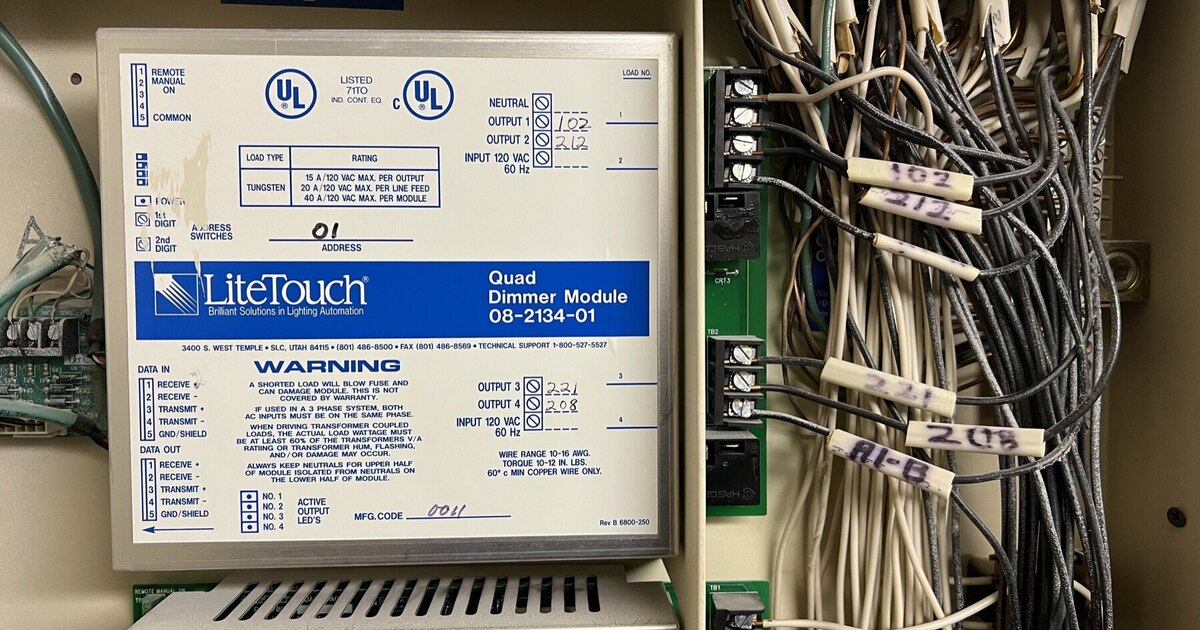
Most coverage of the Touche collapse focuses on residential installs, because that’s the audience writing about it online. But Touche’s primary market was commercial — offices, hotels, schools, churches, and healthcare facilities. Residential owners of other discontinued systems — such as those navigating a LiteTouch replacement — face similar dead-end repair situations, though the commercial compliance requirements make Touche especially urgent to address. In the Houston metro, that means corporate campuses in The Woodlands, mid-rise office buildings in Uptown, hotel corridors in the Energy Corridor, private schools in Katy, and churches across the suburbs.
This matters for three reasons residential articles don’t address:
Downtime is not optional. A hotel can’t run a wing of rooms without functional lighting control. An office building with a failed zone panel will have facilities management calls within hours. The urgency is categorically different from a homeowner whose guest room doesn’t dim correctly.
Code compliance is in play. Commercial buildings must maintain lighting controls that satisfy ASHRAE 90.1, Texas energy codes, and — critically — UL924 for emergency egress circuits. A failed or outdated system isn’t just inconvenient; it’s a code exposure.
Building access is more complex. Re-pulling control wiring through a finished hotel corridor or an occupied school classroom requires coordination with building management, phased scheduling, and often after-hours or weekend work. Cost scales differently than residential.
What Touche Hardware You Likely Have
Touche’s architecture centered on a few core hardware categories:
Room Managers served as the zone-level processor and output module, handling 0-10V dimming signals to ballasts and LED drivers in each room or zone. These are the units most likely to develop faults, and the ones for which no replacement parts now exist.
SmartPack panels were the central controllers, typically rack-mounted in an electrical or IT closet, managing multiple room zones. If the SmartPack is the failing component, the entire building’s lighting logic is at risk.
0-10V Expansion Modules provided additional dimming outputs for buildings with high zone counts. These communicated back to the SmartPack over Touche’s proprietary bus.
Emergency Shunt Control Modules were UL924-listed relay modules for emergency egress circuits — a code-critical distinction we’ll return to in detail below.
Occupancy sensors and wall controls were Touche-proprietary and communicate using Touche’s protocol. None of these can be retrained to work with a different system; they must be replaced.
What Carries Over and What Doesn’t
This is the practical question facility managers ask first. Here’s the breakdown:
Reusable: line-voltage wiring. The 120V and 277V home runs from your electrical panels to junction boxes at each fixture remain fully usable. Conduit, junction boxes, and the home-run cable itself represent the most expensive part of any commercial electrical installation — and all of it stays. This is the primary cost savings in a Touche replacement.
Case-by-case: low-voltage control wiring. Touche used 18 AWG/2C point-to-point runs for 0-10V signals. LOXONE’s Tree bus uses a 4-wire topology (Cat5e or equivalent) that differs architecturally. In smaller buildings and single-room deployments, existing low-voltage runs may be adaptable. In larger commercial installations with long runs through finished ceilings, some control cable re-pull may be required. A site survey before design is the only way to give a definitive answer.
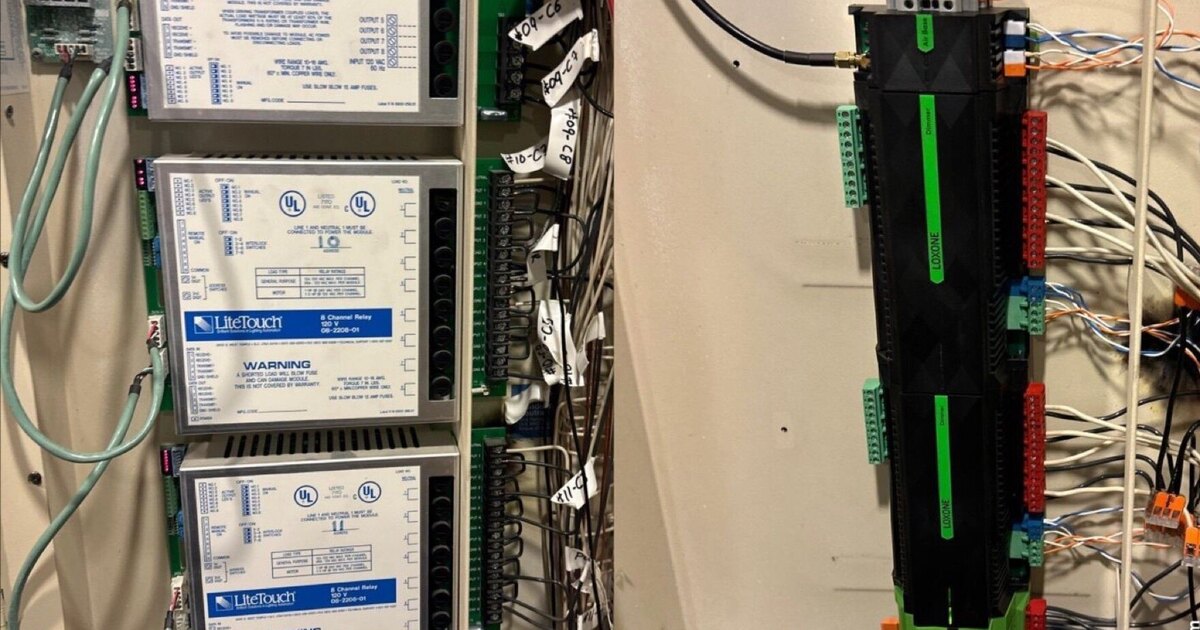
Not reusable: Touche controllers and modules. Room Managers, SmartPacks, expansion modules, and wall controls must all be replaced. There is no firmware bridge, no adapter, and no third party continuing Touche’s protocol.
Not reusable: Touche occupancy sensors. Third-party sensors compatible with LOXONE must be specified. This is typically a straightforward substitution with equivalent or better detection coverage.
The Emergency Lighting Pitfall (Read This Before You Design Anything)
This is the section that most Touche replacement articles skip, and it’s the one that can cause a commercial project to fail inspection.
Under UL924, emergency egress lighting circuits — the lights that must stay on or come on automatically during a power failure or fire alarm — can only be controlled by UL924-listed devices. LOXONE is not UL924-listed. A LOXONE relay or dimmer cannot be the sole control device on an emergency circuit.
Touche addressed this with its own UL924-listed Emergency Shunt Control Modules — relay-only or 0-10V versions depending on the circuit. When replacing Touche, those emergency circuits require either:
- A new UL924-listed emergency shunt relay module (specified from a compliant manufacturer) wired in series with the circuit, with LOXONE controlling only the non-emergency switching, or
- Retention of an existing compliant emergency relay device if it’s still functional and code-compliant.
Every commercial Touche replacement we design at Grizzly Tec maps emergency circuits explicitly during the survey phase. The LOXONE zones and the UL924-compliant emergency control are designed as a coordinated system, not as an afterthought.
If an integrator is quoting your building and this question hasn’t come up, ask about it directly before signing anything.
How the Replacement Process Works
Step 1: Site survey and zone documentation. Touche projects often lack complete as-built drawings. Before any design work, we walk the building and document every zone: circuit type, voltage, dimming protocol (0-10V vs. relay-only), emergency designation, sensor locations, and panel locations. This typically takes half a day for a single-floor commercial building.
Step 2: System design. Based on the survey, we specify LOXONE hardware for each zone: Miniserver, Tree Extensions, Analog Output Extensions for 0-10V control to retained LED drivers, Dimmer Tree modules where full dimmer replacement is needed, Relay Extensions for switching-only zones, and the emergency circuit strategy. Wall controls and occupancy sensors are specified with compatible third-party hardware.
Step 3: Phased installation. We cut over zone by zone — typically one room or one circuit group at a time. In occupied buildings, we coordinate with facilities to schedule zone cutovers outside operational hours where required. Lighting remains available in all zones not actively being converted.
Step 4: Programming and commissioning. LOXONE programming handles scenes, schedules, occupancy response, daylight harvesting, and energy reporting. We configure the system to meet or exceed the building’s original energy code requirements under ASHRAE 90.1 — including occupancy setbacks and daylight sensor response. You receive admin-level access to LOXONE Config.
Step 5: Handoff and documentation. We produce updated as-built zone documentation so the next technician — or your facilities staff — has a complete reference. This is something many Touche buildings never had.
Why LOXONE for Commercial
We install LOXONE — so read this section with that context. That said, here’s why we chose it as our replacement platform for commercial Touche buildings. If you’re unfamiliar with the platform, our plain-English guide to what LOXONE is covers the fundamentals before you evaluate it against other options.
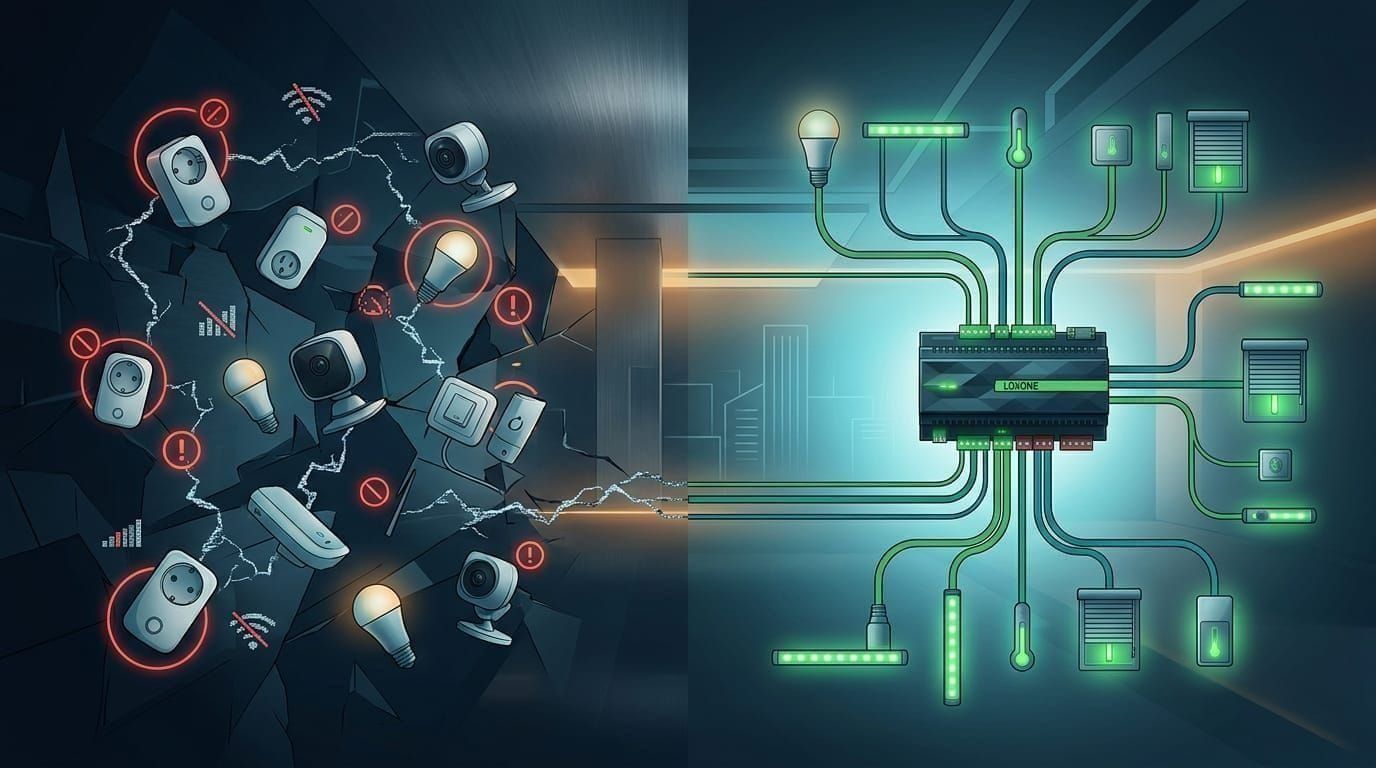
LOXONE is purpose-built for building automation at the commercial scale. The Tree bus architecture is designed for structured wiring in commercial buildings, not for retrofit-friendly wireless mesh. The Miniserver Gen 2 handles thousands of I/O points. The Analog Output Extension provides native 0-10V control, which maps directly to the LED drivers Touche was already using. There are no cloud subscriptions, no per-seat licensing, and no vendor-controlled features that can be removed after purchase.
For energy code compliance, LOXONE’s scheduling, occupancy control, and daylight harvesting are configurable to meet ASHRAE 90.1 requirements out of the box. The built-in logic engine handles the kind of zone-group programming — conference room presets, corridor nighttime step-down, perimeter daylight harvesting — that commercial facilities need.
The main alternative at this price tier is Lutron Quantum, which is a mature commercial platform with strong code support but significantly higher hardware cost and a more closed ecosystem — similar dynamics to what owners of discontinued Lutron GRAFIK Eye systems face when evaluating their upgrade paths. Crestron is another option for buildings already running Crestron AV systems. For buildings where cost is the primary driver and complexity is low, relay-only replacement with simpler commercial timers is a viable option for basic on/off control — but loses the dimming, scheduling, and reporting capabilities Touche provided.
What to Do Now
If your Touche system is still running, the question isn’t whether to replace it — it’s when. Every month of delay is another month of running on hardware with no support path, no replacement parts, and no firmware updates. Systems that fail in occupied buildings typically do so at the worst possible time.
Start with a site survey. We offer free consultations for Houston-area commercial buildings. A half-day walk-through establishes zone count, wiring conditions, emergency circuit map, and a realistic replacement budget before you commit to anything.
If your system is actively failing — a zone is unresponsive, a Room Manager is showing errors, or a SmartPack is rebooting — contact us now. We prioritize active failures over planned replacements in the service queue.
Grizzly Tec is a LOXONE Platinum Partner based in Spring, TX, serving the greater Houston metro. Texas security license #B-29733501. We have installed and replaced commercial lighting control systems in the Houston area since 2015.
Ready to discuss your smart home project?
Book a free consultation — we'll discuss your goals and outline options.
Book a Free ConsultationShare this article
Founder & Mechatronics Engineer
Daniel Lopez founded Grizzly Tec in 2012 and has designed and installed over 1,000 LOXONE automation systems across the greater Houston area. A mechatronics engineer by training, he holds a Texas security license (B-29733501) and has been a LOXONE Partner since 2015, achieving Platinum Partner status — the highest dealer certification level.