

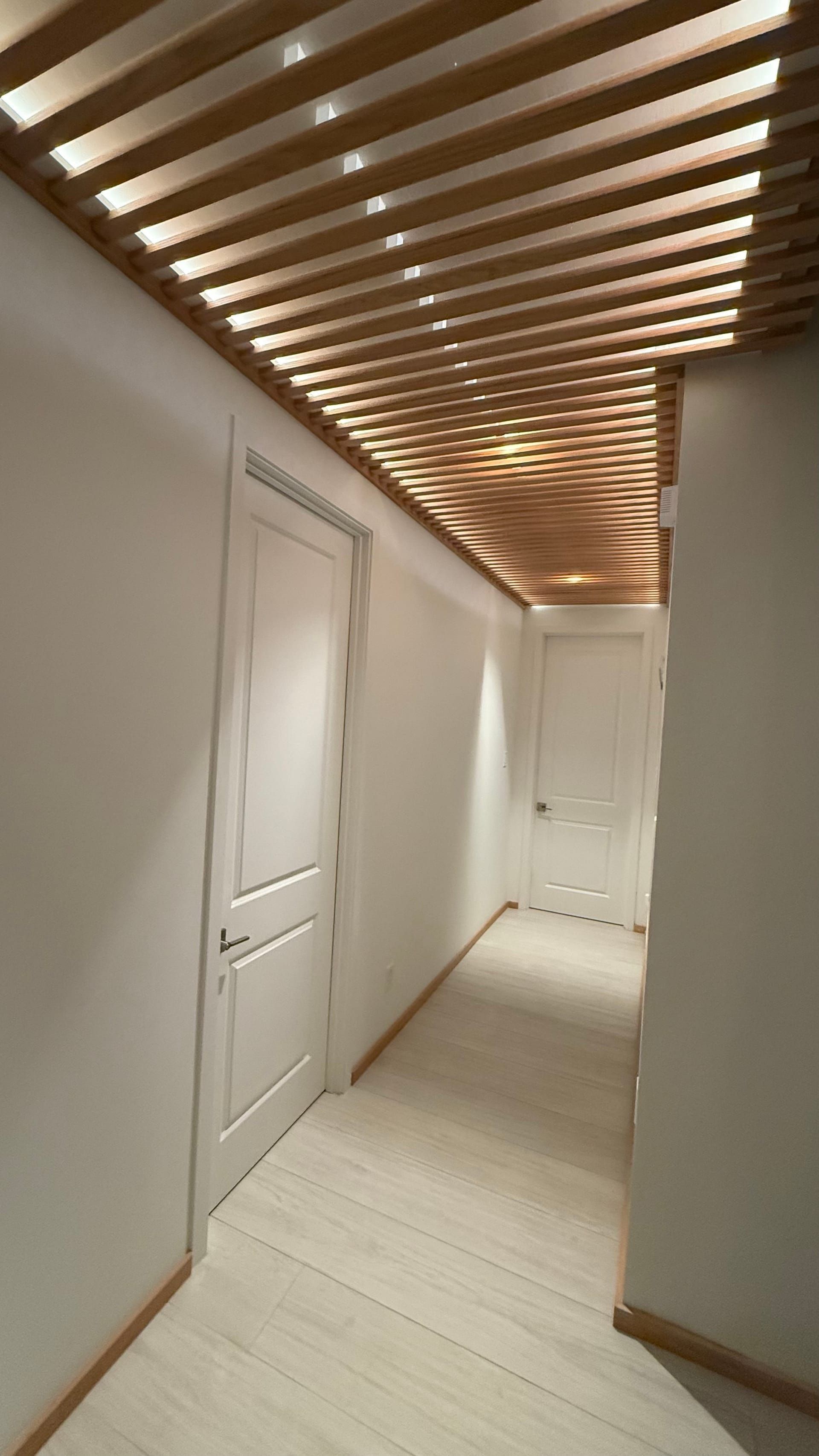
Inside a Nassau Bay Home Where the Lights Are the Alarm
Nassau Bay, TX · 2024
- silent verification window
- 60s
- of existing alarm wiring reused
- 100%
- Texas DPS license
- B-29733501
A Nassau Bay family replaced their old alarm panel with a Loxone Miniserver — same wiring, new brain. Now the house flashes when a door opens after a 60-second silent verification, and Southwest Dispatch sends the police if nobody disarms in time.
The Challenge
Every space we design starts with the same question: how is this room actually going to be used? The challenge here was no different — the client wanted a system that disappears into the architecture and respects how they live.
The Approach
One Loxone Miniserver. One app on the wall. One design philosophy: the system should answer questions before you have to ask them, and stay invisible the rest of the time.
A back patio door opens at 9:47 PM on a Tuesday. The family is on vacation. The Miniserver registers the zone event and starts a silent 60-second clock. No lights flash. No siren. Just a notification on the homeowner’s phone 1,500 miles away: “Patio door opened. Verify within 60 seconds or full alarm engages.”
The homeowner is at dinner. The phone is in the hotel safe. Sixty seconds pass.
At second 61, every interior light in the Nassau Bay home flashes white at full brightness. The exterior floodlights kick on. The siren ramps up. Southwest Dispatch — the UL-listed central monitoring station — receives the alarm event and begins its verification protocol. Within another minute, Nassau Bay police are dispatched.
Whoever was on the patio doesn’t wait around to find out what happens next.
This isn’t Ring. This isn’t ADT. This is a Loxone Miniserver running a Texas-DPS-licensed monitored security system, retrofitted into an existing Nassau Bay waterfront home by Grizzly Tec. The smart home is the security system.
The Nassau Bay home and the problem worth solving
Nassau Bay sits on Clear Lake near Galveston Bay. The homes are largely waterfront. Large glass facades. Boat docks. Seawalls. The neighborhood profile includes NASA-area professionals and retirees who travel — meaning houses are often empty for stretches at a time.
This family had an existing alarm panel. It worked. Door and window contacts wired to a conventional zone-based system, motion sensors in key rooms, a wall-mounted keypad in the hallway. The panel itself was reliable, but it lived in its own silo. It didn’t know whether anyone was actually home. It didn’t talk to the lights. It didn’t see the cameras. It didn’t shift behavior when the family was traveling.
The family wanted one system that ran everything — lighting, climate, audio, locks, cameras, and the security panel. Not five apps for five things. One brain.
The retrofit — same wiring, new brain
The existing alarm wiring was in good condition. Door and window contacts in conduit, properly terminated. There was no reason to rip it out.
What changed:
- The conventional alarm panel was removed.
- A Loxone Miniserver was installed in the equipment closet.
- The existing door, window, and motion sensors were re-terminated to Loxone digital inputs.
- Loxone Tree extensions handled additional sensors added during the upgrade.
- The existing lighting circuits were brought under Loxone control.
- A cellular backup link to Southwest Dispatch was configured for monitored police dispatch.
The keypad on the wall stayed. It just talks to a new brain now.
The 60-second verification window — why the delay matters
When a sensor trips in armed mode, the system does not immediately flash the lights or call the police. It starts a silent 60-second verification clock.
This is by design. False alarms are the single biggest problem with conventional residential security. The homeowner walks in through a side door, forgets they armed the system, the panel screams, the neighbors get woken up, the monitoring station calls the police, the city issues a false-alarm permit violation, and the homeowner pays a fine.
The 60-second silent verification window solves this. During those 60 seconds:
- The Miniserver tracks the sensor state.
- A push notification goes immediately to the homeowner’s phone with a “disarm” prompt.
- The keypad displays the verification countdown.
- If a valid disarm code is entered (at the keypad or via the Loxone app), the system resets silently. Nothing further happens.
If 60 seconds pass with no valid disarm code, the system commits to the full alarm response.
Second 61 — what actually happens
- 61.0s — Lights command goes out across the house. Every interior fixture wired into the alarm scene flashes on at full brightness, then off, then on — strobing.
- 61.5s — Exterior floodlights engage. Front, sides, patio, dock.
- 62.0s — Siren engages at full volume.
- 62.5s — Cellular signal to Southwest Dispatch. The operator sees the alarm event with zone information — which door, which window, which motion sensor.
- 63.0s — Push notifications go out to the homeowner’s phone, the spouse’s phone, and any designated neighbor or family contact.
Southwest Dispatch then begins its verification call sequence. If no answer or no proper response, Nassau Bay police are dispatched per standard protocol.
Vacation mode, night mode, away mode, home mode
The system isn’t one binary “armed / disarmed.” It’s contextual:
Vacation mode — auto-engaged by geofence + manual confirmation. All perimeter sensors at maximum sensitivity. Interior motion active. Lights run randomized “occupied” patterns: kitchen on at 7 PM as if someone is cooking, primary bedroom on at 11 PM, off by 11:30. The patterns vary day to day — a watching eye outside the seawall can’t predict them.
Night mode — engaged when the family is home but sleeping. Perimeter armed. Interior motion disabled (people get up at night). A trigger flashes exterior and common-area lights but skips the bedrooms — the family doesn’t get blinded out of bed.
Away mode — daytime, last person leaves. Geofence + locked front door = auto-arm. Standard verification window and alarm response.
Home mode — family is home, doors might be open, kids in the yard. Perimeter sensors disarmed. Only specific high-value zones (the safe room, the wine cellar, the workshop) stay armed.
Why local processing matters for security
Ring goes down when your internet goes down. So does Nest. So do most cloud-dependent “smart” alarm systems — partially or entirely, depending on the model.
A Loxone-based system processes alarm logic on the Miniserver, which sits in the equipment closet on local power with battery backup. If the cable modem dies, if the ISP has an outage, if the router is being rebooted — the lights still flash, the siren still sounds, the doors can still lock. The connection to Southwest Dispatch rides on cellular backup specifically so police dispatch is independent of the home’s internet.
Security that fails when the Wi-Fi blips is not security.
The Texas DPS license angle
Texas requires a Private Security Bureau license (Class B) to install or service alarm systems that signal a monitoring center. Grizzly Tec holds License #B-29733501 — verifiable on the Texas Department of Public Safety public license database.
A smart-home installer without that license can legally do notifications-only systems (“we’ll send you a text when the door opens”), but cannot legally configure a system that signals a monitoring station for police dispatch. The Loxone-as-security-system approach only works when the installer is licensed for it. Grizzly Tec is.
Technical detail — security stack
Security hardware and dispatch chain
- 1× Loxone Miniserver — runs alarm logic locally, no cloud dependency
- Existing door/window contacts and motion sensors — re-terminated to Miniserver digital inputs
- Loxone Tree extensions — additional zones added during the upgrade
- Cellular backup — independent path to Southwest Dispatch UL-listed monitoring station
- Texas DPS License #B-29733501 — required to signal monitored police dispatch
Outcomes
Comfort goes up. The decisions the system used to ask the homeowner to make — which playlist, which lights, which setpoint — happen automatically. The house feels intentional instead of operated.
"Same wires. Better brain. Now the alarm is part of the house, not a stranger in the closet."
— Homeowner, Nassau Bay
Services used in this project
Want something like this?
Tell us about the house, the room, or the problem. We'll walk it with you and design the system around how you actually live.
Start a conversation