

The Cypress Home With 18 HVAC Dampers and Zero Thermostats
Cypress, TX · 2024
- HVAC dampers
- 18
- wall switches doubling as temp sensors
- 25+
- thermostats on the wall
- 0
How one Cypress home cools only the rooms you're actually in. 18 dampers, room-by-room temperature control, and zero thermostats on the wall — because every Loxone switch is the sensor.
The Challenge
Every space we design starts with the same question: how is this room actually going to be used? The challenge here was no different — the client wanted a system that disappears into the architecture and respects how they live.
The Approach
One Loxone Miniserver. One app on the wall. One design philosophy: the system should answer questions before you have to ask them, and stay invisible the rest of the time.
In a Cypress home Grizzly Tec designed and installed, there isn’t a single thermostat on the wall.
There are 18 HVAC dampers in the ceiling. There are Loxone wall switches throughout the house. And there’s one piece of automation logic running on a Loxone Miniserver in the closet.
What’s missing is the wall thermostat — the single round dial that decides the temperature of an entire zone of a house. The Cypress homeowner doesn’t have one, doesn’t need one, and never wants one again.
The freezing-room / hot-room problem you’ve already lived with
If your house has a single AC zone, you’ve felt this: the thermostat in the hallway reads 72°F. You’re sitting in the west-facing office. It’s 79°F. The kids are upstairs in a north-facing bedroom. It’s 76°F. The master bath is 68°F because it’s right under the supply vent.
Your AC is running. Your bill is high. And nobody in the house is comfortable at the same time.
This isn’t a thermostat problem. It’s a sensor count problem. A traditional HVAC system makes decisions for an entire zone based on the temperature of one spot — usually a hallway wall, picked because the contractor needed somewhere to put it.
Houston makes this worse than most cities. Big homes (4,000–8,000 sq ft is normal in Cypress and the suburbs), big sun exposure, big humidity load, and a 102°F afternoon make the gap between rooms enormous. The west-facing rooms cook at 4 PM. The shaded rooms stay cool. One thermostat can’t represent both.
The fix: 18 dampers, room-by-room sensing
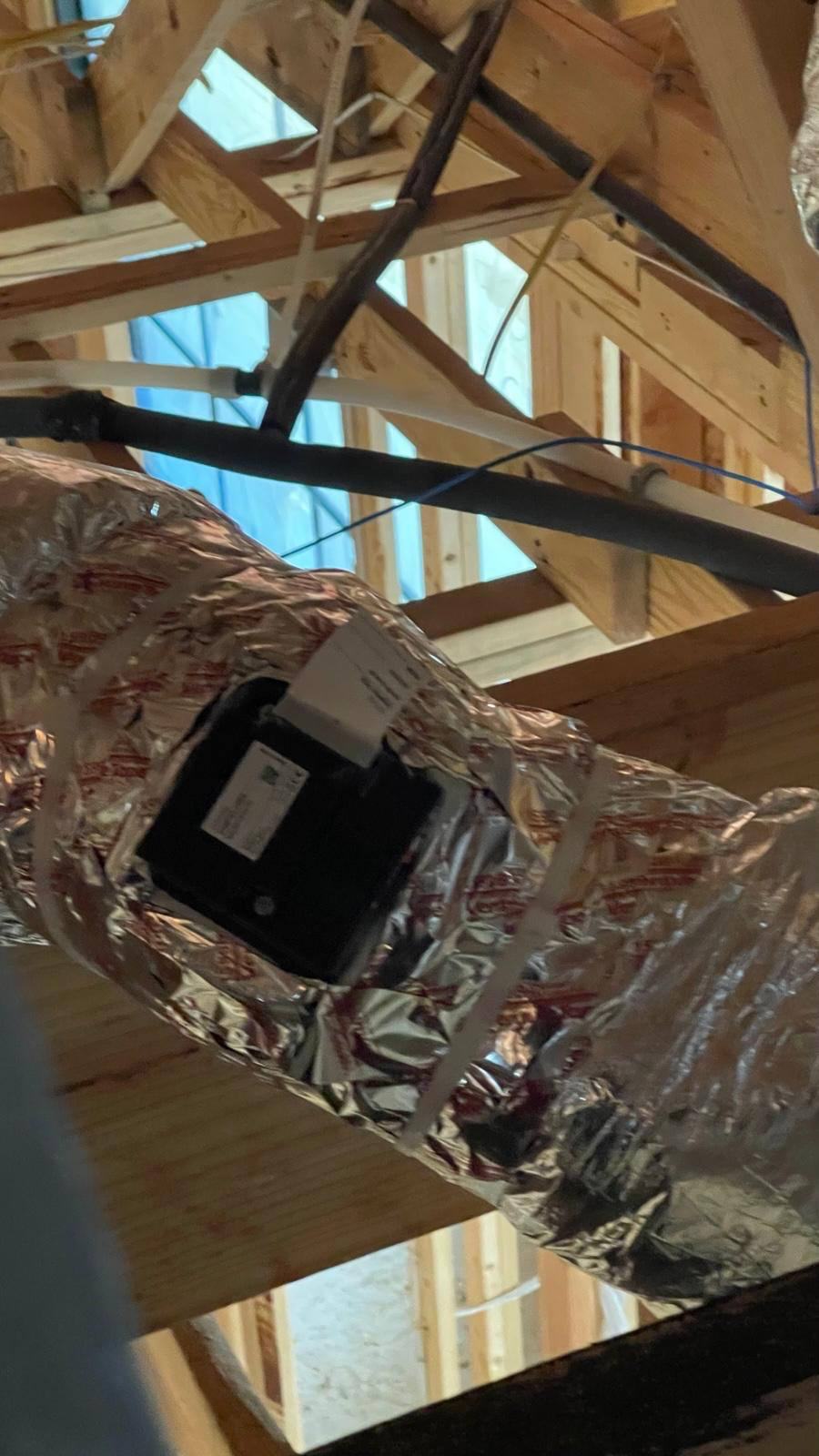
The Cypress home runs an 18-damper multi-zone HVAC system. Every major room in the house — kitchen, living, dining, study, primary bedroom, primary bath, secondary bedrooms, game room, media room, and the secondary spaces — has its own motorized damper in the ductwork.
The dampers open or close based on actual room temperature.
The actual room temperature comes from the Loxone wall switches.
Every Loxone Touch wall switch is also a temperature sensor. That’s the part most homeowners don’t know. The same switch that turns on the lights also reads the room temp. The Miniserver reads from all of them continuously, compares each reading to that room’s setpoint, and tells the corresponding damper to open or close.
One spot of truth becomes a spot of truth in every room.
What a day in this house feels like
3:00 PM — pre-cool the study
The west-facing study has glass on two walls. By 3 PM in August it’s the hottest room in the house. The system knows this — it learned over time, and there’s a scene that runs every weekday at 3 PM. The damper opens, supply air diverts into the study, and the room drops from 78°F to 71°F before the kids come home from school. By the time homework starts at 4 PM, the room is comfortable. Nobody had to ask.
Meanwhile, the formal dining room next door — empty, unused, north-facing — is at 76°F. Its damper is closed. Conditioning that space at 3 PM would be wasted cooling.
6:00 PM — family hours
Kitchen and living room scene. Kitchen damper open. Living damper open. Family room damper open. Both kids’ bedroom dampers stay at setback (74°F). The system is conditioning ~40% of the home’s volume — not 100% — and yet every space the family is actually using is at the temperature they want.
9:30 PM — bedtime
Primary bedroom scene. Damper opens. Setpoint drops from 73°F to 70°F over 20 minutes. By the time the homeowners walk in to brush their teeth, the room is already at sleeping temperature. Kids’ rooms have their own setpoints — also dropped, but at slightly different times because the routines are different.
The kitchen and living room dampers close. Those spaces drift up overnight to 76°F at the setback. The HVAC system stops working overtime to cool empty space.
7:00 AM — Sunday morning
Weekend scene. Kitchen damper opens early. Coffee machine is already going. Living room damper follows. The bedrooms stay cool and quiet for the family that’s sleeping in.
Why this matters
Two outcomes, both real:
-
Comfort goes up. No more “the office is hot, the bedroom is cold” arguments. Every room is at the temperature it should be, when it should be there. The house doesn’t feel like a thermostat fight.
-
Energy use goes down. Not because the setpoint changed — but because the system stops conditioning empty space. A 6,000 sq ft home that only cools the occupied ~40% during family hours, and only the bedrooms overnight, is doing dramatically less work than a single-zone system running the whole envelope to one setpoint.
Technical detail — the hardware
Climate control hardware
- 1× Loxone Miniserver — local processor. Runs the control loop, no cloud, no monthly fees.
- 18× motorized HVAC dampers — integrated with the central air handler via 0-10V or relay control.
- Loxone Touch wall switches — every switch is a temperature sensor. The system reads from all of them, every minute, all day.
- Per-room setpoints + scene-based setback — bedrooms cool at night, daytime spaces cool during the day, unused rooms hold at setback.
No internet required. No subscription. The homeowner has the admin password and full programming access.
Outcomes
Comfort goes up. The decisions the system used to ask the homeowner to make — which playlist, which lights, which setpoint — happen automatically. The house feels intentional instead of operated.
"I don't think about temperature anymore. It's just right."
— Homeowner, Cypress
Services used in this project
Want something like this?
Tell us about the house, the room, or the problem. We'll walk it with you and design the system around how you actually live.
Start a conversation