Crestron vs Savant vs LOXONE: Which Smart Home System Is Right for Houston Homeowners?
Crestron, Savant, and LOXONE are the three systems Houston homeowners most often encounter when budgeting a whole-home automation project above $30,000. Each can run your lights, audio, HVAC, shading, and security — but they differ dramatically on cost structure, who controls the programming, and how the system behaves when your internet goes out during a Gulf storm.
This comparison is written by a Loxone Partner since 2015 (Platinum today), so you deserve a straight disclaimer: we install LOXONE, not Crestron or Savant. What follows is based on installs in the Houston area since 2012, conversations with homeowners who’ve transferred from all three platforms, and typical project pricing we’ve seen quoted in the Houston market — Crestron and Savant pricing below reflects our experience and industry estimates, not published dealer list prices. Where LOXONE wins, we’ll say so plainly. Where it doesn’t, we’ll say that too.
What You Actually Get at Year One: Cost Breakdown
The number that most homeowners ask about first is year-one cost. Here’s a realistic range for a 4,000–6,000 sq ft home in an area like The Woodlands, River Oaks, or Cypress — covering lighting control, multi-zone audio, HVAC integration, shading, and a network backbone.
| System | Year-One Hardware + Install | Annual Ongoing Cost |
|---|---|---|
| Crestron | $80,000 – $250,000+ | $3,000 – $8,000 |
| Savant | $40,000 – $150,000+ | $1,500 – $5,000 |
| LOXONE | $20,000 – $80,000 | $0 platform fee |
Crestron and Savant figures above are estimated ranges based on typical Houston-area project scopes in our experience — not published Crestron or Savant list pricing.
A few notes on these ranges. Crestron’s ceiling is effectively unlimited — in our experience, a Memorial-area estate with a commercial-grade processor, multiple 10” touch panels, and a full AV matrix can push past an estimated $400,000 in hardware alone. Savant’s middle range is where most Houston luxury installs land, based on projects we’ve seen: roughly $60,000–$90,000 for a well-appointed home with Savant Pro remotes, in-wall panels, and a Core system. LOXONE projects in the same scope typically come in at $35,000–$55,000.
The ongoing-cost column is where LOXONE separates itself most clearly. Savant’s cloud-based remote access requires a Pro subscription (an estimated $9.99–$19.99/month), and most dealers layer a support agreement on top. Crestron dealers regularly bill an estimated $150–$300/hour for any programming change, based on rates we’ve seen quoted in the Houston market, and annual maintenance contracts are standard. LOXONE charges zero platform fees — the Miniserver runs locally, the app is free, and there is no annual line item.
What’s Included vs. What Costs Extra
With Crestron, almost every new capability is a programming job. Add a thermostat? Programming fee. Add a new lighting scene? Programming fee. The hardware is modular and powerful, but the cost of change is ongoing and dealer-dependent.
Savant is more app-driven and slightly more accessible for minor changes, but the ecosystem is still closed. Dealers guard the backend, and homeowners rarely get credentials.
LOXONE hands you the admin password at project close. Our smart home automation clients can add devices, create scenes, and modify schedules themselves — or call us. The choice is theirs.
Programming Flexibility: Who Owns Your System?
Here’s a question worth asking any dealer before you sign: “If your company closes tomorrow, can I get full access to my system?”
With Crestron and Savant, the honest answer is usually no — or at least not easily. Both platforms use proprietary programming environments (SIMPL Windows and Simpl# for Crestron; Savant Blueprint for Savant) that require licensed dealer access. If your installer goes out of business or you move to a different city, transferring the programming to a new dealer often costs an estimated $5,000–$15,000 in re-programming fees, based on quotes we’ve seen in the Houston market.
LOXONE Config is the programming tool, and the .loxone project file belongs to the homeowner. Any LOXONE-certified integrator anywhere in the world can open it, understand it, and extend it. That’s not a marketing claim — it’s the file format being openly documented.
The Admin Password Question
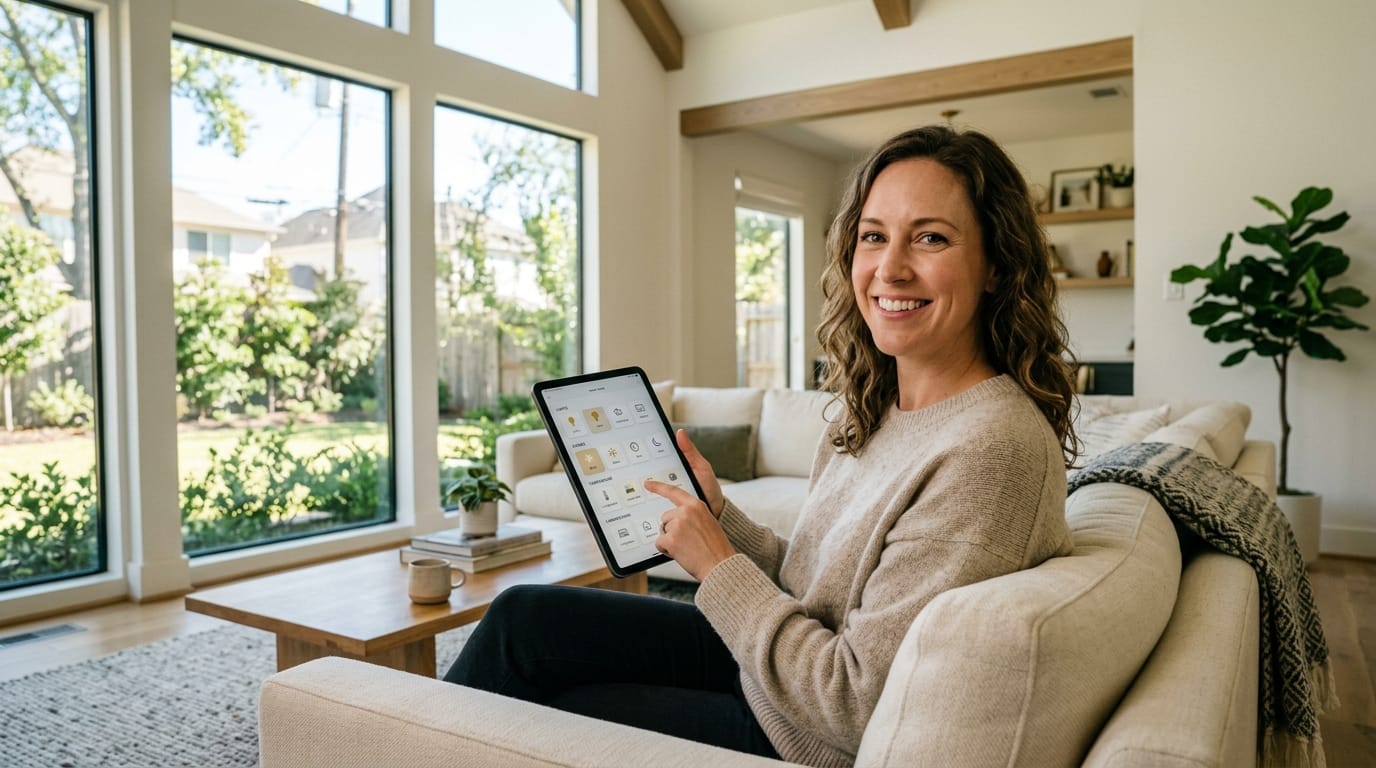
Grizzly Tec’s policy: you get the admin password the day the system is commissioned. You can log into the Loxone app with full control, access the web interface, and see every device on your network. This is a non-negotiable part of how we work.
This matters most during events like Harvey-scale flooding, a corporate relocation, or a home sale where the new buyer wants to understand what they’re inheriting. Owning the credentials means you own the asset — not just the hardware.
Design Language: Touch Panels, Remotes, and the Phone
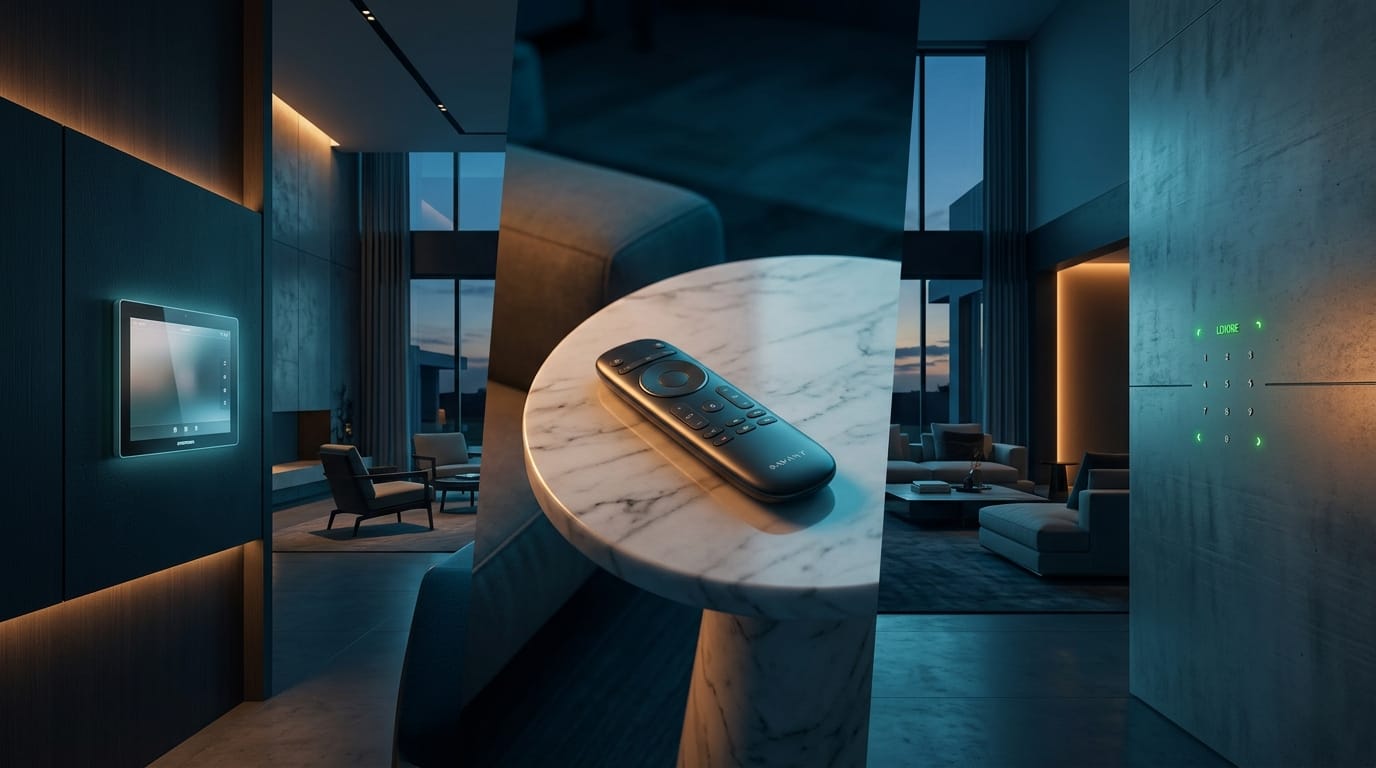
Walk into a Savant home and the first thing you notice is the hardware design. Savant’s handheld remotes — machined aluminum, portrait orientation, physical buttons — are genuinely beautiful objects. Their in-wall touchscreens have an Apple-adjacent quality that reads as luxury. Interior designers in Houston’s River Oaks and Tanglewood neighborhoods have been specifying Savant partly because of how the hardware photographs.
Crestron’s design language is more institutional. The touchscreens are functional and durable — you see them in Four Seasons hotels and corporate boardrooms — but they don’t have the same residential warmth. In a $4M home, they can feel out of place next to custom cabinetry.
LOXONE keypads (Tree and Air series) are Austrian-designed, flush-mount, and elegant without being precious. They’re available in multiple finishes and read well in both modern and transitional interiors. The Touch Pure, in particular, disappears into a wall almost completely. What you notice is that you barely have to touch anything — the house responds to presence, time of day, and scene — and you never had to pull out your phone.
The Phone Dependency Problem
Savant and Crestron are, at their core, app-first systems. Beautiful apps, but apps. That means if the app is slow, if the cloud is down, or if your phone is charging in the other room, you’re hunting for a workaround.
LOXONE is wired-first and presence-first. The system knows when you walk into a room and adjusts lighting based on natural light levels and time of day — without you doing anything. One client in Cypress described it this way: “My kids have friends over constantly, and I haven’t touched a light switch in eight months.” That’s the design goal.
How Each System Handles a Real Houston Day
It’s 6:20 AM on a July morning in Katy. The sun is already bright, humidity is 88%, and your pool equipment is on a schedule. Here’s what each system does without you:
Crestron: Executes the programmed morning scene perfectly — lights ramp up, HVAC adjusts, shades open. If you want to change anything, you open the app or use a touch panel. Everything works as programmed. Nothing surprises you.
Savant: Similar execution, with a slightly more consumer-friendly app experience. The Savant remote on your nightstand is a pleasure to use. You press one button and the morning routine fires.
LOXONE: The lights warm gradually starting at 6:10 AM because the Miniserver read the sunrise time for Katy, TX (it updates daily). The HVAC pre-cooled overnight when rates were lower. Your outdoor irrigation ran at 4 AM because the system detected no rain in the forecast and the soil sensor was dry. You didn’t set any of that up last night. You woke up and the house had already been working.
The distinction isn’t dramatic on any single morning. Over a year, it’s the difference between a programmable house and a responsive one.
Storm Season in Houston: What Happens When the Internet Goes Down
CenterPoint outages during hurricane season are a real operational concern in the Houston metro. During Hurricane Beryl in July 2024, parts of Houston lost power for 7–12 days. Even homes with generators face internet outages when ISP infrastructure is damaged.
All three systems have some local processing capability. Crestron’s processors are fully local. Savant’s core functions work locally but cloud features drop. LOXONE is designed from the ground up for local-only operation — every automation, every schedule, every sensor runs on the Miniserver without touching the internet. When the router is dark, the house still works.
For the greater Houston area, this isn’t a theoretical edge case. It’s a design requirement.
Audio and Video: Where Each Platform Shines
Crestron’s AV matrix capabilities are in a class of their own for large estates. If you have a 15-zone audio system, a dedicated home theater, a sports bar, and a pool cabana all requiring independent sources and independent control, Crestron handles that topology without compromise. Our multi-zone audio and video integration projects in the $100,000+ range often start with clients who’ve been quoted Crestron and want to understand the alternatives.
Savant’s audio integration is particularly strong for music listening. The Savant Music platform, combined with their remotes, delivers a high-end listening experience that audiophile-leaning clients appreciate. The interface prioritizes album art and artist browsing in a way Crestron doesn’t.
LOXONE’s LOXONE Audioserver handles up to 10 independent zones and supports local library playback, streaming services, and line-in sources. One kid hears their playlist in their room while you and your spouse listen to something different in the kitchen and the backyard speakers play ambient music for guests — all managed from one interface, no subscription required. For most residential installs, this covers the full scope. For a 20+ zone commercial estate, you may look at integrating a dedicated audio matrix.
Where LOXONE’s lighting design and automation integration is hardest to match is in how audio and lighting work together automatically. When a “Movie Night” scene fires, the overhead lights dim to 15%, the bias lighting behind the TV warms to 2700K, and the television input switches — with no app interaction. You pressed one button on the keypad. Or you didn’t press anything, because the kids were already in the theater room and the system read occupancy.
Networking: The Foundation That Decides Everything
Every one of these systems lives or dies by the network underneath it. A Crestron processor on a flat, unmanaged consumer network will behave worse than LOXONE on a well-designed Ubiquiti or Cisco Meraki infrastructure.
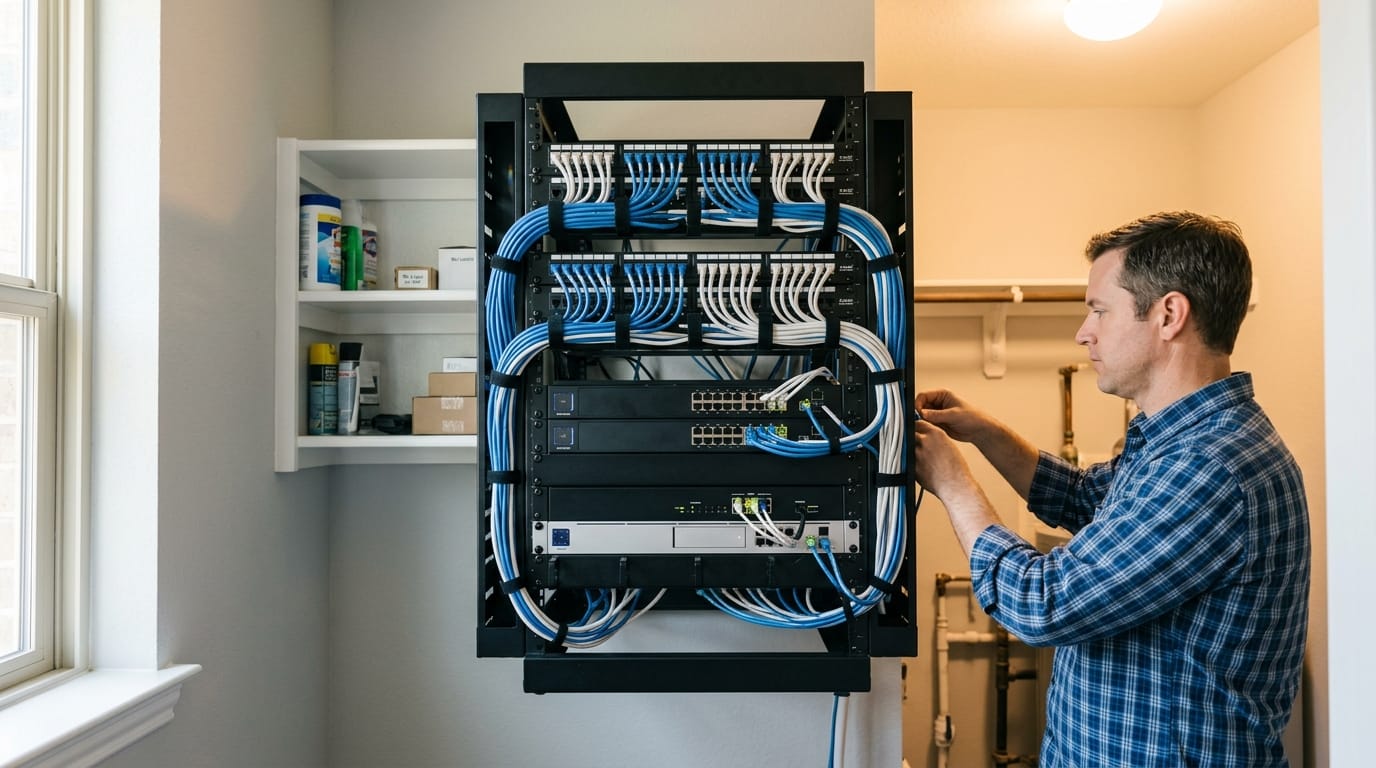
Our structured networking and wiring work is part of every installation we do, regardless of automation platform. This is not optional. The homes we inherit from other integrators — Savant, Crestron, Control4, or LOXONE — almost always have networking as the root cause of their reliability problems. Flapping Wi-Fi, unmanaged switches, a consumer router routing smart home traffic and 4K streaming on the same SSID with no QoS rules.
For new construction in Spring, Conroe, or Tomball where the builder is doing pre-wire, specifying Cat6A to every room and a properly sized network enclosure adds roughly $3,000–$6,000 to the rough-in budget and saves $8,000–$15,000 in troubleshooting costs over the life of the system. We cover this in detail in our LOXONE vs Control4 Houston comparison, but the principle applies across all three platforms.
Not sure which system fits your Houston home?
Book a free 15-minute call. We’ll tell you honestly whether LOXONE is the right fit — or point you somewhere else if it isn’t.
Schedule a Free Consult →When Crestron or Savant Is the Right Answer
We’d be doing you a disservice if we pretended LOXONE is always the right call. Here’s when the other systems make more sense:
Choose Crestron if: You’re building or renovating a 10,000+ sq ft estate with a dedicated AV integrator, a 20+ zone audio-visual matrix, and a facilities manager who will handle ongoing programming. The depth of Crestron’s control protocol integrations is unmatched — it can talk to virtually any commercial AV device ever made. The cost is real, but so is the capability ceiling.
Choose Savant if: Industrial design and Apple-ecosystem integration are top priorities, and you’re comfortable with ongoing dealer support costs. Savant’s HomeKit integration is tight, the hardware is beautiful, and for clients who are already deep in the Apple ecosystem and want that continuity, it’s a natural fit.
Choose LOXONE if: You want a system that runs locally, costs less over five years, gives you full ownership, and handles lighting, audio, HVAC, and security as one integrated intelligence rather than a collection of connected devices. For the majority of Houston residential projects between $1M and $5M in home value, LOXONE delivers what the other two charge twice as much to provide.
You can read a broader take on the landscape in our smart home systems comparison, which covers more platforms side by side.
The 5-Year Total Cost of Ownership
Year one is the number people focus on. Year five is where the real picture emerges.
As an illustrative example based on typical Houston project scopes in our experience: for a $65,000 Savant install with a $3,000/year support agreement and modest programming changes, you’re at roughly $83,000 by year five. For a comparable $45,000 LOXONE install with zero platform fees, you’re at $45,000 — or $52,000 if you’ve had us out for a couple of expansion projects. That $30,000 difference in a 5-year window buys significant home improvements, furnishings, or simply stays in your pocket.
For new construction builders in the Houston metro, this math is part of what we present in our builder pre-wire program. The homebuyer who understands the 5-year cost of ownership is a more confident buyer — and a more satisfied client.
Frequently Asked Questions
How much does Crestron cost for a whole-home installation in Houston?
A whole-home Crestron install in Houston typically runs an estimated $80,000–$250,000+ depending on scope, based on typical Houston project scopes in our experience — Crestron doesn’t publish list pricing. That includes hardware, licensed dealer programming, and commissioning. Annual support and update agreements commonly add an estimated $3,000–$8,000 per year on top.
Does Savant charge monthly fees?
Savant itself doesn’t charge a per-month subscription, but its app and cloud features require a Savant Pro subscription (an estimated $9.99–$19.99/month for remote access) and dealers often charge an estimated $1,500–$5,000/year for ongoing support agreements, based on typical Houston project scopes in our experience. Budget accordingly.
Can I get admin access to my Crestron or Savant system?
In practice, Crestron and Savant dealers almost never give homeowners full admin-level programming access. Changes require calling your dealer and paying programming fees — an estimated $150–$300/hour based on rates we’ve seen quoted in the Houston market. LOXONE is different: Grizzly Tec hands clients the full admin password at project close.
Which smart home system works without internet?
LOXONE runs on a local Miniserver with zero cloud dependency — it works fully when your internet is down. Savant and Crestron can process some commands locally, but cloud features and remote access drop when connectivity is lost. For Houston, where power and internet outages during storm season are common, local processing matters.
Is Crestron or Savant better for a luxury home in River Oaks or The Woodlands?
Both handle luxury-tier installs well. Crestron has a longer commercial and estate track record; Savant emphasizes Apple-like design polish. LOXONE is increasingly chosen in the same price range because it combines luxury performance with no annual fees and full owner control — a compelling combination for a $2M+ home.
What is the cheapest professional smart home system in Houston?
Among professionally installed whole-home systems, LOXONE typically has the lowest total cost of ownership. Year-one installs start around $15,000–$25,000 for a mid-size home, with zero ongoing platform fees. Savant and Crestron entry points run higher and carry annual support costs.
Can I switch smart home systems later if I want to?
Switching is always possible but involves real cost. With Crestron and Savant the wiring is typically reusable, but programming is proprietary and rarely transferable. LOXONE uses standard Cat5e/Cat6 tree wiring, and since clients own the config file, transitions are significantly easier than with closed dealer-gated systems.
By Daniel Lopez, Mechatronics Engineer & Loxone Partner since 2015 (Platinum today)
Ready to discuss your smart home project?
Book a free consultation — we'll discuss your goals and outline options.
Book a Free ConsultationShare this article

Founder & Mechatronics Engineer
Daniel Lopez founded Grizzly Tec in 2012 and has designed and installed 1,000+ projects (audio, video, networking, security and automation), including 50+ LOXONE projects. A mechatronics engineer by training, he holds a Texas security license (B-29733501) and has been a LOXONE Partner since 2015 and a Platinum Partner today.