01 — STOA FINE CIGARS + SPIRITS
The Lighting Design Behind Houston's Most Exclusive Cigar Lounge
- Lighting Layers
- 0
- Architecture
- 24V
- Control Brain
- 0
Slowing down with a good cigar requires a room that knows how to slow down with you.
Stoa Fine Cigars + Spirits is a members-oriented lounge in Houston where the product is time. The lighting had to earn that reputation — atmospheric without artifice, refined without effort. Not a performance of luxury. Luxury itself.
02 / THE CHALLENGE
Exclusive without trying. Atmosphere doing the work.
The owner came to us with a precise ask: make the room feel like somewhere. Not a bar with good cigars. Not a fancy humidor. A destination — the kind of place that earns return visits through mood, not marketing.
The challenge with commercial hospitality lighting is avoiding the two failure modes: too dim to feel safe, too bright to feel intimate. Neither works for a cigar lounge. The answer isn't a compromise. It's layers.
"The brain reads the room as 'expensive' before you can say why. That's the job."
Daniel Lopez, Grizzly Tec
03 / THE APPROACH
Five independent layers. Every channel dimmable. One Miniserver.
Warm-white Loxone RGBW throughout — no color tricks, no programmed theatrics. The color capability exists in reserve. The design decision was to never use it.
"Disciplined restraint is the most expensive thing you can put in a room."
01 / LIGHTING
The architecture of atmosphere.
Five independent layers, all warm-white, all independently dimmable. The room doesn't perform mood — it holds it.
Philosophy
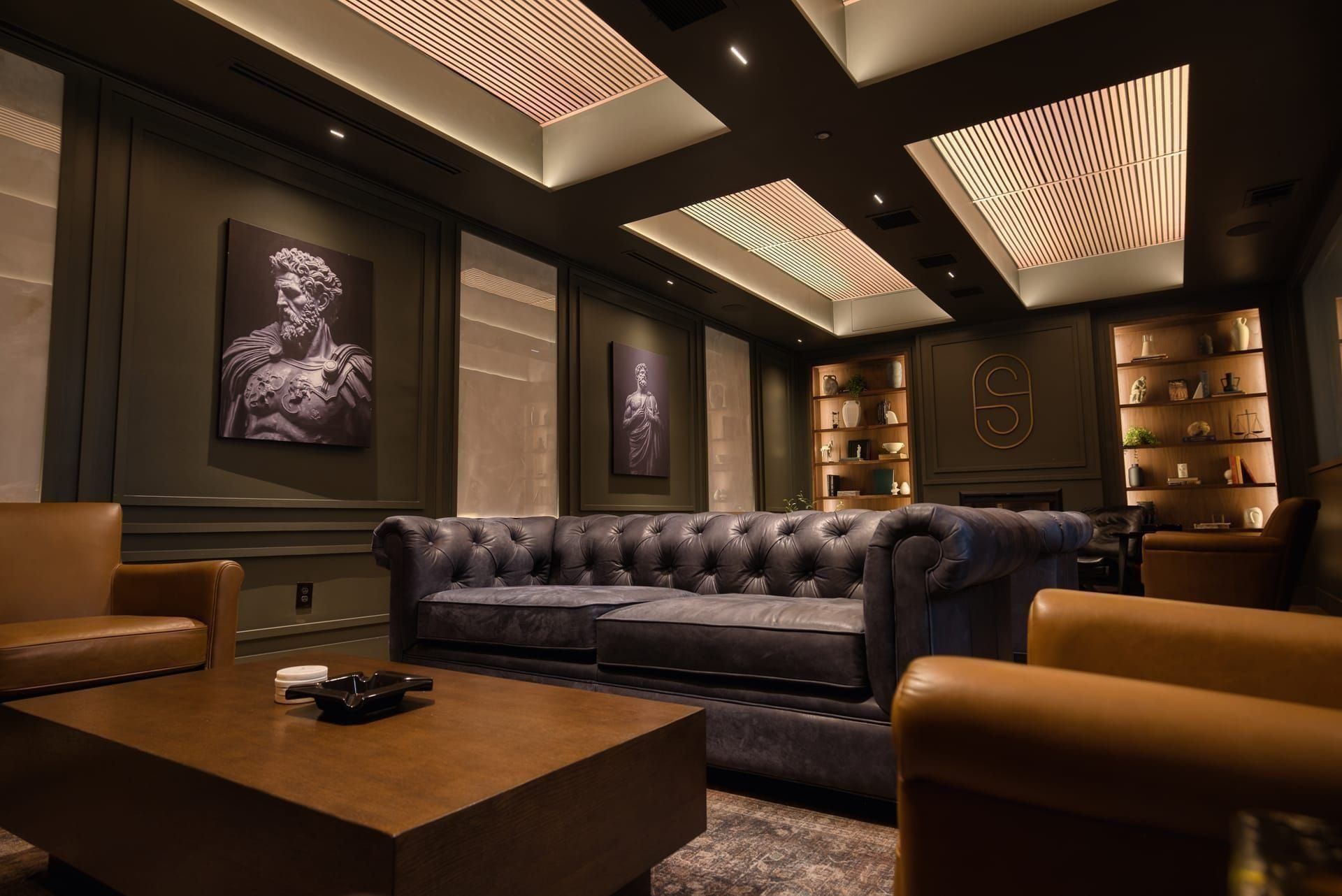
Flat lighting fills a room. Layered design composes one. Each layer does a single job — ambient warmth, accent on art, glow on objects, navigation underfoot — and the moment they stack, the room stops feeling lit and starts feeling alive.

Five layers.
One mood.
No visible light source.
04 / The lighting system
Five layers.
One mood.
Atmosphere is not a single fixture — it is five independent channels balanced against each other. Scroll to reveal each layer.
Cove
Continuous warm-white LED tape concealed inside the ceiling cove, running the full length of the room. Light hits the ceiling first and washes down — diffuse, sourceless, the ambient mood from which everything else departs.
Slab
A stone slab replaces what would normally be a window — and a single horizontal tape light at its base washes upward across the stone. The slab becomes a glowing feature wall. You see the stone lit, not the source.
Art Lights
Concealed ceiling fixtures aim warm beams directly at each artwork. You don't see the fixtures — you only see the art illuminated from above. In a room without windows, art lights replace the horizon.
Cabinet
Vertical LED tape concealed on both sides of the humidor and bar back. The light glows inward toward the cigars and bottles — invisible source, illuminated product. You notice the object, not the strip.
Downlights
Recessed and dimmed far below their rated output. Not there to illuminate — there to keep the cove from feeling hollow. Calibrated so a guest can read a label without squinting.
Scroll to reveal each layer
04½ / Try the lighting yourself
Toggle each layer on and off.
Feel what each one contributes.
Every layer is independently addressable. This is what Loxone control actually means — not a slider, but a complete architectural decision at your fingertips.
Drag each slider to dim · Tap a layer name to toggle
01 — Cove
75%
Continuous warm-white LED tape concealed inside the ceiling cove, running the full length of the room. Light hits the ceiling first and washes down — diffuse, sourceless, the ambient mood from which everything else departs.
07 / SEE THE DIFFERENCE
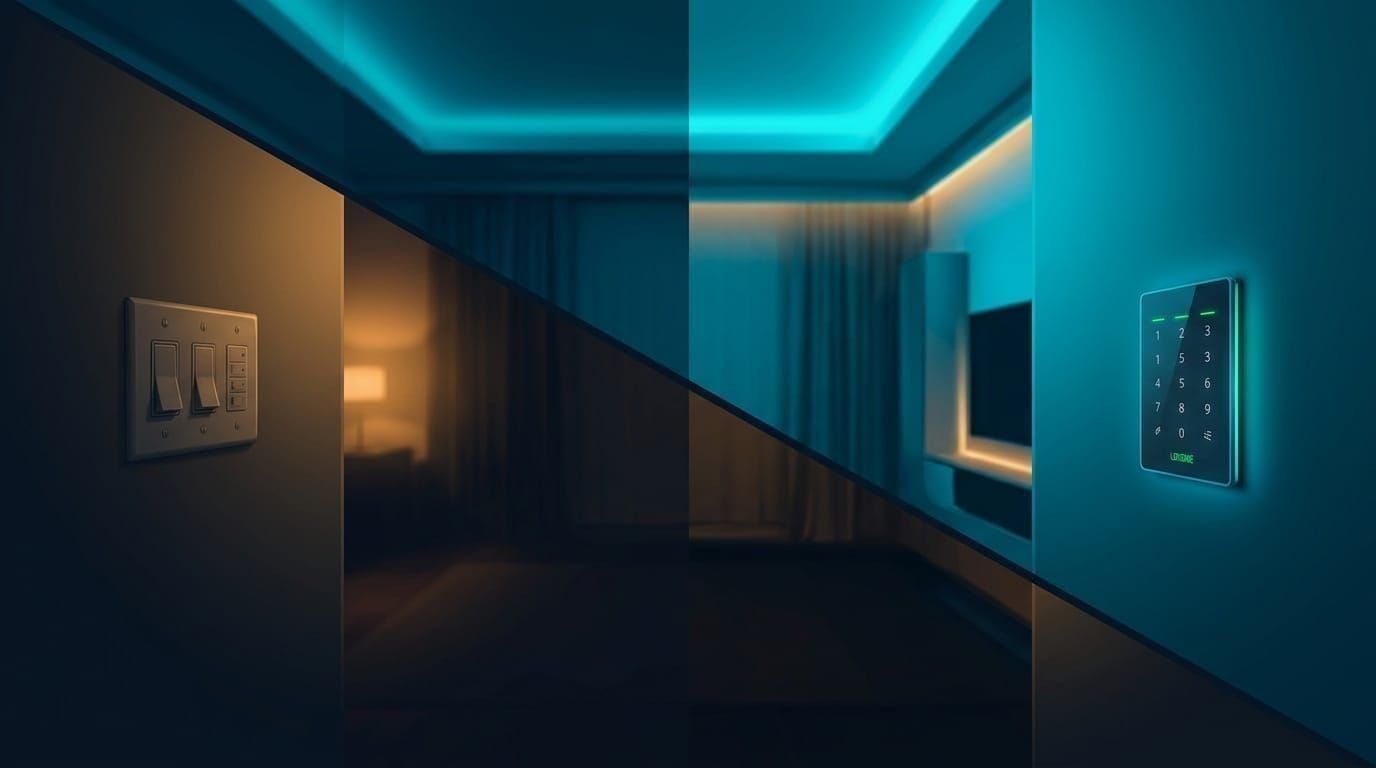
Flat lighting vs. layered design.
Same room. Different lighting design.
"The brain reads the room as 'expensive' or 'moody' or 'designed' without being able to say why."
Restraint as luxury
Every fixture runs on the warm-white channel. The RGB capability of each RGBW unit is held in reserve — a deliberate choice. Color would cheapen the room. Restraint is what makes it feel expensive.
Contrast within low brightness
Running five layers at 8–15% each yields more depth than one layer at 60%. The eye needs variation to read space. The indirect cove at low percentage creates a ceiling that glows rather than a ceiling that illuminates.
08 / THE LAYOUT
Where each layer lives in the room.
Tap any hotspot to explore
09 / THE HARDWARE
One Loxone Miniserver runs every dimming curve. Five layers, one brain, zero monthly fees.
02 / AUDIO
The sound that holds the room.
Audio at Stoa lives on a Loxone Audioserver, with separate zones for the lounge, the bar, and the patio. Each zone has its own preset volume and source — the bar plays jazz at a sociable level, the lounge sits at quiet ambient, the patio carries a livelier feel for the evening crowd. When the lighting scene shifts at 9 PM, the audio shifts with it: warmer presets, lower volumes near the seating, slightly elevated in the back zone. The room doesn't change — it transitions. We'll cover the full audio architecture in a follow-up case study.
02 / Audio system
One room, four zones, one feel.
+ Show technical detail Hide technical detail
03 / VENTILATION
Smoke handled invisibly.
The engineering problem of a cigar lounge is invisible to the guest — and that's the point. Stoa runs dedicated exhaust fans, makeup air supply, and controlled pressure differentials all orchestrated by Loxone. Occupancy-linked schedules ramp exhaust when the room fills, pull back when it empties, and maintain negative pressure relative to the entryway so smoke stays in the lounge, not the lobby. The Miniserver watches CO₂ levels and adjusts fan speed continuously. Guests smell cedar, not smoke. We'll detail the full ventilation design in the dedicated case study.
What we'll cover
+ Show technical detail Hide technical detail
04 / PRESENCE
The room that knows you arrived.
Loxone presence sensors are placed throughout Stoa — at the entry, in each seating zone, and near the humidor. When a guest moves into a section of the room, scenes respond: lighting brightens slightly in that zone, ventilation adjusts, audio fades up a touch. When the lounge is empty for a defined period, the system pulls back into a low-energy standby — lights dim to 3%, fans throttle down, audio mutes. No manual switches. No staff intervention. The room manages itself, and it makes guests feel attended to without a staff member in sight. Full presence logic walkthrough coming soon.
What we'll cover
+ Show technical detail Hide technical detail
05 / ACCESS
Membership, not just entry.
Stoa distinguishes between member entry, guest entry, and after-hours access — all managed through Loxone. The humidor is a separate controlled zone: members with a reserved cabinet have keyed-access via NFC credential. After-hours, the system runs a timed lockdown sequence that disarms specific entry points, locks the humidor zone, and sets a holding scene that looks attended-to from the street. Staff can override remotely via the Loxone app without being on site. Access credentials are time-bound and tied to Loxone schedules, not a separate system that needs its own management. Full access architecture coming in a dedicated case study.
What we'll cover
+ Show technical detail Hide technical detail
06 / SECURITY
Protected without feeling protected.
High-value inventory — premium cigars, aged spirits, private-member humidor cabinets — demands a security layer that's invisible to the guest experience and unambiguous to any threat. Stoa runs monitored alarms integrated with Loxone presence, cameras on critical zones including the humidor and the bar back, and an after-hours trigger path routed through Southwest Dispatch. When motion is detected after lockdown, Loxone fires the alarm sequence, the camera system timestamps the event, and Southwest Dispatch receives the signal automatically. No manual call required. We'll document the full security integration in a dedicated case study.
What we'll cover
+ Show technical detail Hide technical detail
05 / AT EVERY MOMENT OF THE DAY
"Happy hour, 7:00 PM. The room rises to meet the night."
06 / THE ROOM IN DETAIL
Every corner earns its place.
Fireplace corner — cove + downlight at 10% each
Seating + screens — art lights at 20%
Humidor cabinet — internal cabinet lights
Full atmosphere — all five layers active
10 / FROM THE OWNER
Daniel and the Grizzly team built the room I imagined but couldn't describe.
— Stoa Fine Cigars + Spirits
Owner interview — coming soon
11 / Different moods, same hardware
One Miniserver.
Every scene imaginable.
Stoa runs a carefully chosen fixed scene. But the Loxone system underneath is capable of anything. Here's what the same room would feel like at different moments in the day.
Late Night Scene
Deep warm, very dim. All five layers running at 8–12%. The room becomes its own world. Nothing is visible that wasn't meant to be seen. This is the full design — the design as intended.
Stoa runs a fixed scene. Loxone supports unlimited presets — the system is ready when the room evolves.
Want something like this?
Tell us about the space, the room, or the problem. We'll walk it with you and design the system around how you actually live — or host.
Featured on Loxone International's commercial reference list — view on loxone.com →
← All case studies