What Is Circadian Lighting — and Is It Worth Installing in Your Houston Home?
Circadian lighting automatically shifts the color and brightness of your home’s lights throughout the day — cool and energizing in the morning, neutral through the afternoon, warm and dim by evening — without you adjusting a single switch. It’s one of the few smart home upgrades that changes how you feel, not just how your house behaves.
Most Houston homeowners encounter circadian lighting as a feature buried in a smart home brochure. This post explains how it actually works, what it costs to install, when it makes sense to add it, and what separates a system that quietly improves your life from one that’s just an expensive scheduled dimmer.
How Circadian Lighting Actually Works
Your body’s sleep-wake cycle is regulated partly by light. Blue-enriched, high-intensity light in the morning signals wakefulness and suppresses melatonin. Warm, low-intensity amber light in the evening does the opposite — it signals your brain that the day is winding down. Most homes fight this biology constantly: bright cool LED overheads blazing at 10 PM while everyone tries to wind down.
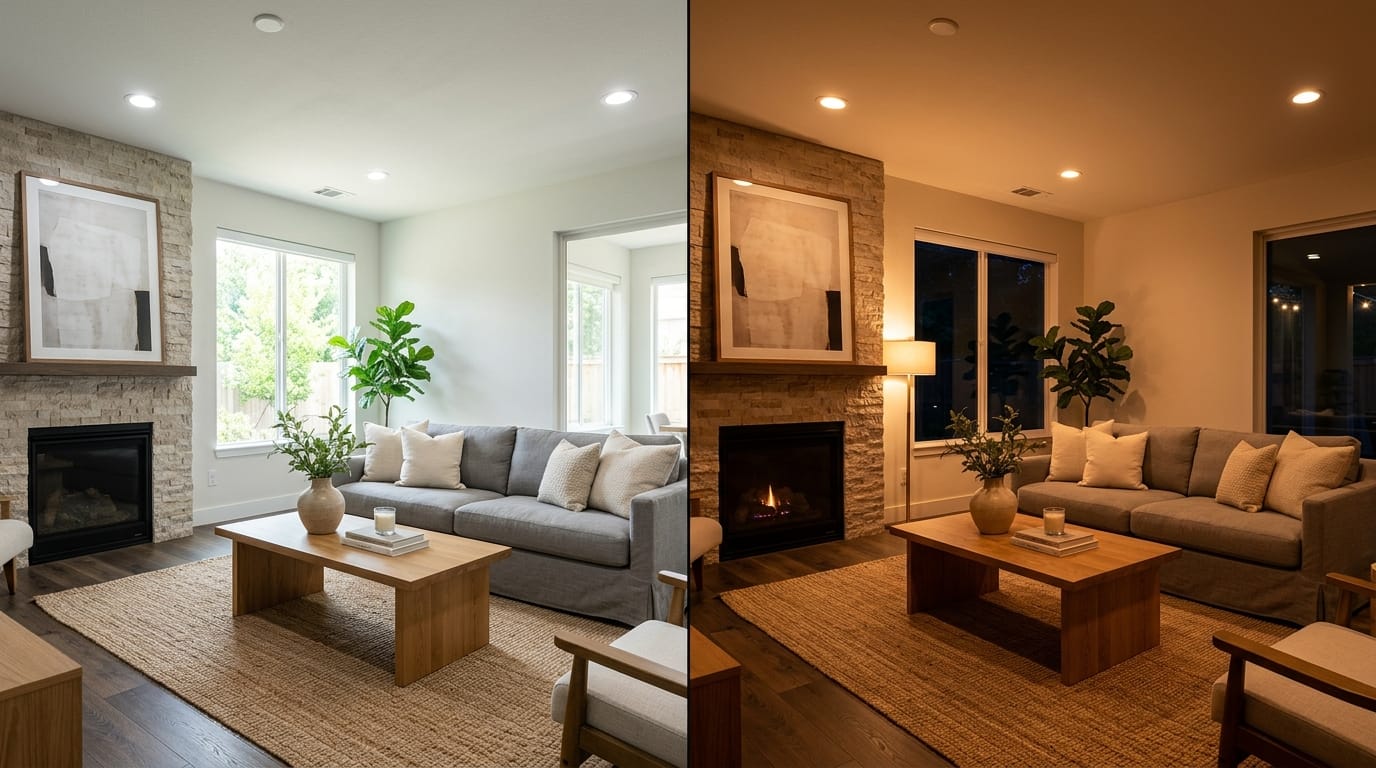
Circadian lighting systems solve this by controlling two separate properties of each light source: brightness (intensity, measured in lumens) and color temperature (the warmth or coolness of the white light, measured in Kelvin). Tunable-white fixtures contain two sets of LED chips — one warm (around 2700K) and one cool (around 6500K). The system blends them in real time according to a programmed curve tied to your local sunrise and sunset times.
What You Actually Experience
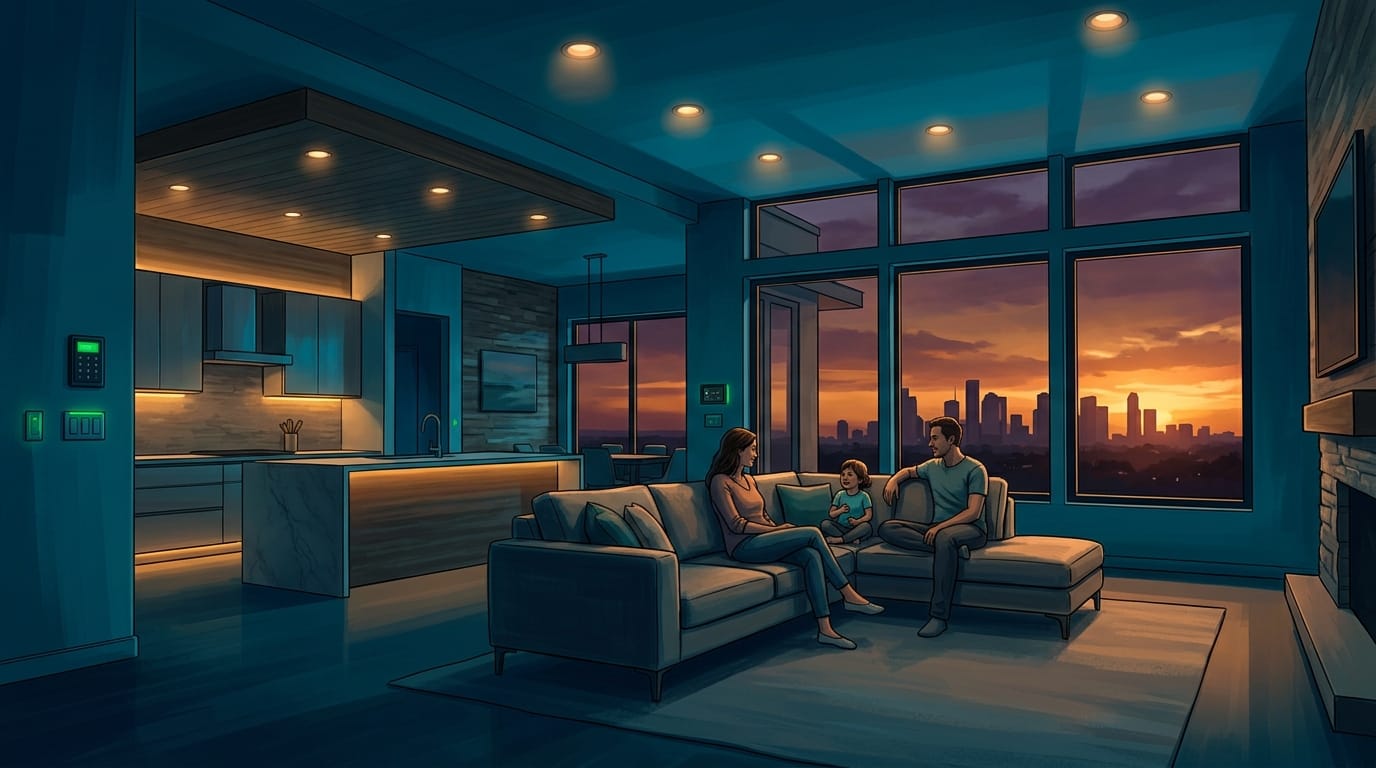
At 7:00 AM, you walk into the kitchen and the overhead lights come on at full brightness in a crisp, slightly cool white — the kind that makes you feel like drinking coffee and starting something. You didn’t touch anything. By 11:00 AM they’ve shifted almost imperceptibly to a neutral white. By 8:30 PM, when you’re settling onto the couch, the living room has dropped to about 30% brightness and shifted to a deep amber — the lighting equivalent of a fireplace. You feel yourself actually relaxing.
That’s not marketing language. That’s what clients in The Woodlands and Cypress consistently describe once the system has been running a few weeks.
The control platform drives this curve automatically. Our lighting design and automation work in Houston increasingly includes circadian tuning as a default, especially in primary bedrooms, kitchens, and home offices.
What It Is Not
Circadian lighting is not color-changing RGB mood lighting (those are entertainment features, not health features). It’s not a Philips Hue starter kit cycling through sunset oranges. A proper circadian system produces only whites — the full warm-to-cool spectrum — across every fixture in the home, consistently and automatically, without you scheduling anything once it’s set up.
What Circadian Lighting Costs in Houston
Prices vary significantly based on fixture count, ceiling access, and the automation platform tying it all together. Here are realistic ranges for the Houston market in 2026.
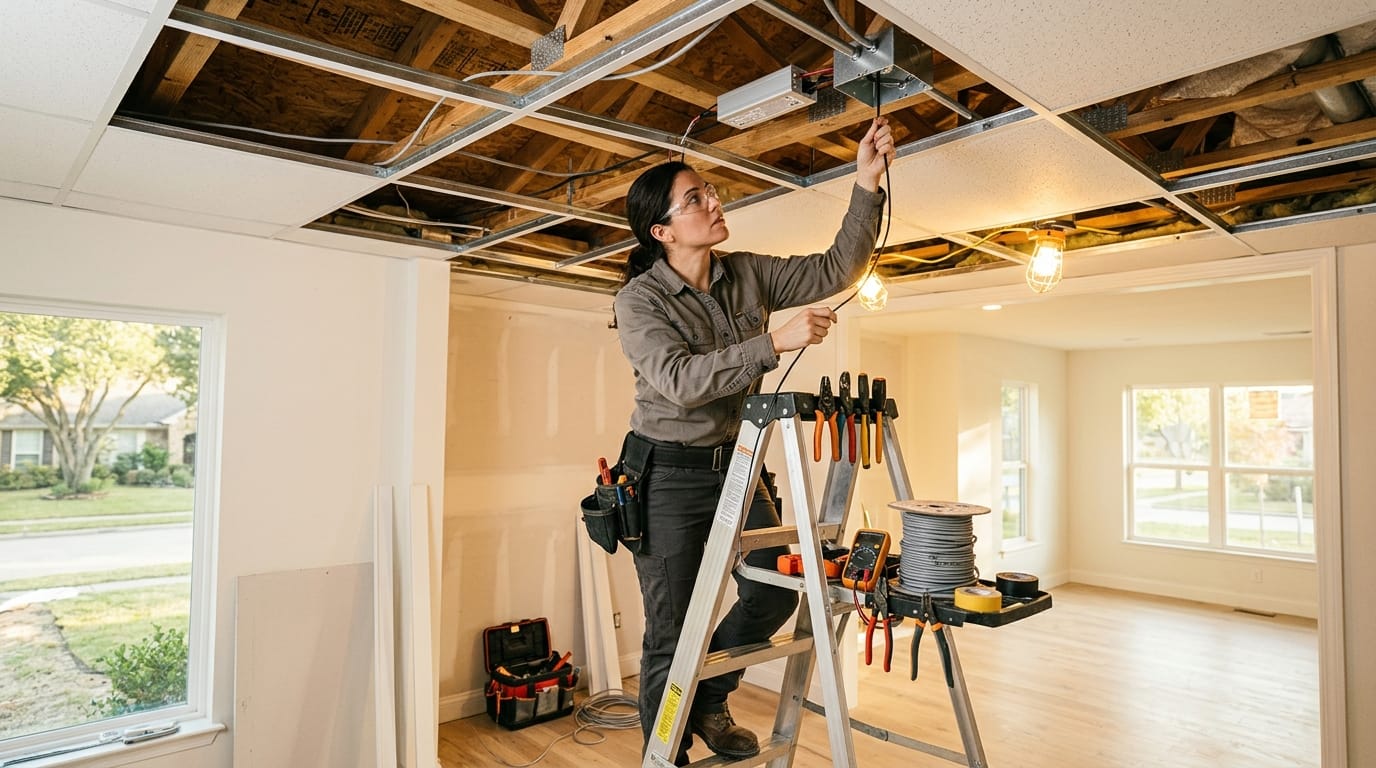
Single-room installation (bedroom or home office): $1,500–$4,000 installed, including a handful of tunable recessed fixtures and integration into an existing smart home platform.
Partial-home system (primary bedroom, master bath, kitchen, main living area — roughly 4–6 rooms): $8,000–$18,000 installed, depending on ceiling type, fixture count, and whether wiring changes are needed.
Whole-home circadian system in a 3,500–5,000 sq ft Houston home: $18,000–$40,000 installed, including all fixtures, wiring, control hardware, and programming. Homes in Memorial or River Oaks with high ceilings and custom architectural details are typically at the higher end of that range.
The cost premium over a standard smart dimming system is roughly 25–40% per room in fixture cost alone. Tunable-white recessed fixtures run approximately $85–$180 per fixture versus $35–$80 for standard dimmable LED trims. For a 4,500 sq ft home with 80 fixtures, that delta is real — but most clients describe it as the upgrade they most wish they’d done sooner.
If you want to understand how circadian lighting fits into a full smart home budget, our post on what a smart home actually costs in Houston breaks down the full picture by project type.
Retrofit vs. New Construction: Which Makes More Sense?
The honest answer: new construction is dramatically easier, and the cost difference justifies doing it right the first time.
New Construction
In a new build, tunable-white fixtures are specified during rough-in and the wiring follows a logical plan from day one. Low-voltage cabling runs cleanly from a central network rack to each fixture group. The automation platform — whether LOXONE, Control4, or another professional system — is programmed during commissioning before the homeowner moves in. The system just works when they walk through the door for the first time.
If you’re building in Spring, The Woodlands, Cypress, or Katy and your builder isn’t already talking to you about circadian lighting during pre-wire, our builder pre-wire program covers exactly this kind of specification work.
Retrofit
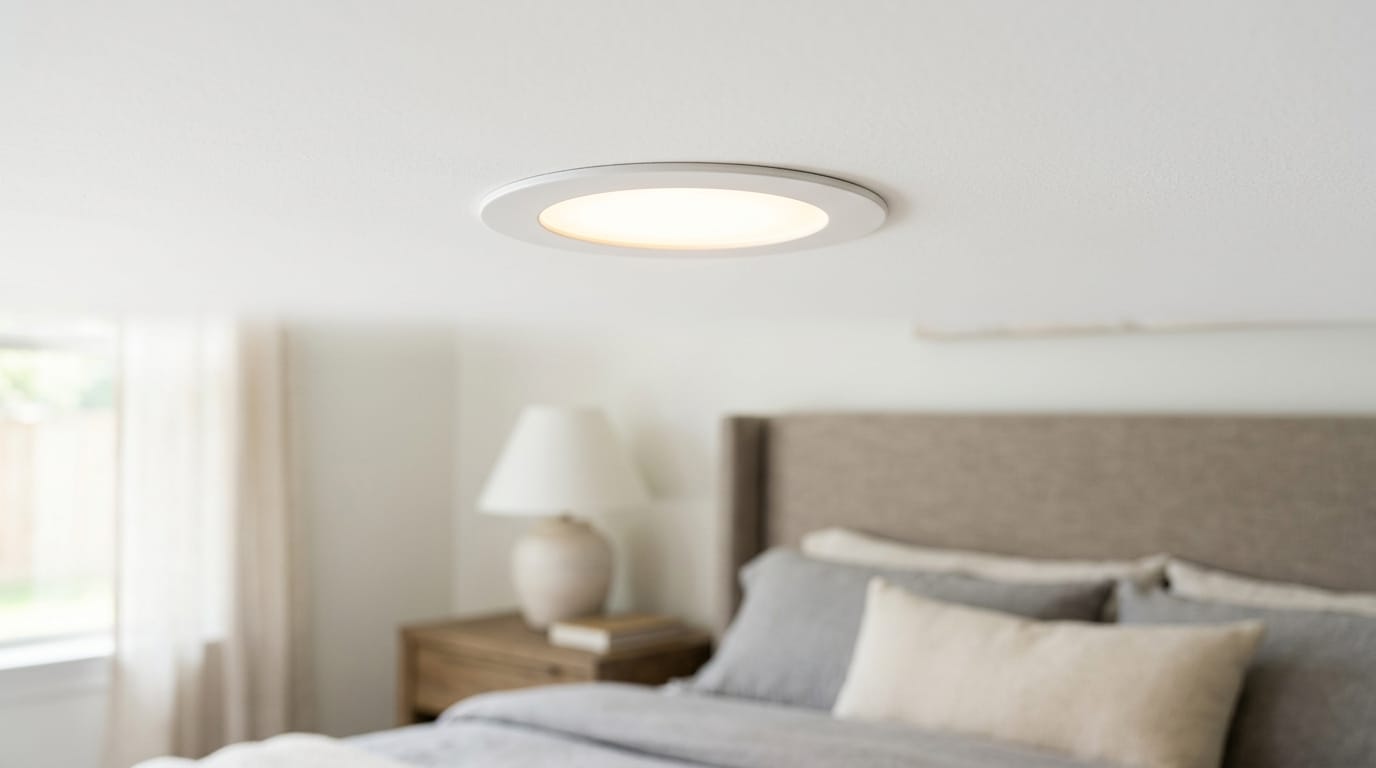
Retrofit is possible, but it adds complexity. Existing wiring may not support the two-channel control that tunable fixtures require. Ceiling access in a finished two-story home can be limited. In homes built before 2010 — common in Memorial, Meyerland, or Westheimer-area neighborhoods — the electrical layout sometimes requires rerouting or the addition of local controllers at each fixture group.
The most common retrofit approach uses DALI or DMX-capable drivers behind standard housings, controlled by a central processor. In open-plan spaces with good attic access, this is very manageable. In rooms with no attic above them (like a first-floor room under a second story), costs go up 20–30% for access work alone.
Our smart home automation team walks every retrofit client through a scope review before any pricing — ceiling access is the first thing we check on a site visit.
Choosing a Control Platform for Circadian Lighting
Not all smart home platforms handle circadian curves the same way.
App-dependent systems (most Wi-Fi bulb ecosystems, some entry-level platforms): the circadian schedule lives in the cloud or on your phone. When the internet goes down — and Houston sees its share of outages during hurricane season — the schedule stops. Firmware updates from the bulb manufacturer can silently break routines. These systems work fine for casual dimming but aren’t reliable enough for a whole-home health-focused installation.
Locally processed systems (LOXONE, some Control4 configurations): the circadian curve is calculated and executed by a processor inside your home. Sunrise and sunset times update from an internal clock. Even with no internet, no app, and no phone interaction, the lights behave exactly as programmed. This is the category we use for clients who want the system to genuinely disappear into the background.
LOXONE’s lighting logic, for example, lets you define a circadian curve by astronomical clock — the system calculates your exact local sunrise and sunset for Spring, TX every day and adjusts the curve accordingly. You can override it with a single tap if you want to read late, but the default behavior requires nothing from you.
The loxone-vs-competition breakdown covers how these platforms compare in depth if you’re early in evaluating options.
For larger projects, the networking infrastructure behind your lighting system matters too. Reliable local-area network performance ensures lighting commands execute in under 50 milliseconds — the difference between a light that feels instant and one that has a perceptible half-second lag.
Houston-Specific Considerations
Houston’s climate creates a few conditions that make circadian lighting more valuable here than in most northern cities.
Texas summers mean many homeowners — especially in Katy, Sugar Land, and The Woodlands — spend the bulk of their daylight hours indoors under air conditioning. From May through September, it’s common to go from a dark bedroom to a car to an office to a car to a dark home without meaningful sun exposure. That pattern disrupts circadian rhythms more severely than it would somewhere with temperate weather.
Indoor circadian lighting partially compensates. A 5,000–6,500K morning wash in the kitchen and home office delivers enough blue-enriched light stimulus to support morning alertness even when you’re not stepping outside until it’s already 95°F.
There’s also a practical code note: Texas does not currently mandate biologically adaptive lighting, but commercial projects in Harris County and Fort Bend County increasingly specify WELL Building Standard compliance, which includes circadian lighting metrics. If you’re planning a custom home that might eventually be used as a rental or commercial space, getting the infrastructure right now avoids a costly retrofit later.
What Good Circadian Lighting Looks Like, Day to Day
It’s worth walking through a full day, because the experience is cumulative.
6:55 AM. Your bedroom lights come on at 10% brightness, a soft warm white — not a jarring alarm-clock glare. Over the next 15 minutes they slowly rise to 60% as you move through the morning routine. You don’t adjust anything.
9:00 AM. The home office is at 80% intensity, 5000K — close to natural overcast daylight. Your eyes feel comfortable on the screen. You haven’t thought about the lights once.
12:30 PM. Lunchtime in the kitchen. 100% intensity, neutral white. Everything looks exactly like it does outdoors on a partly cloudy Texas afternoon.
7:30 PM. Dinner. The dining room has dropped to 65% brightness, 3200K — still enough to see clearly, but the room looks and feels different than midday. Noticeably warmer.
9:45 PM. Living room. 30% brightness, 2700K. Amber-warm. The room feels quiet. Two kids have drifted toward bed without a fight for the first time this week.
10:15 PM. You didn’t touch a switch, open an app, or give a voice command all day.
That’s the outcome the hardware exists to create. We’ve documented similar daily experiences in our guide to whole-home audio in Houston, where the same “disappear into the background” philosophy applies to sound — one consistent experience, no friction, no phone required.
Ready to see circadian lighting in a real Houston home?
We do site visits across Spring, The Woodlands, Katy, and the greater Houston metro. Bring your floor plan and we’ll tell you exactly what’s possible.
Schedule a free consultation →Is Circadian Lighting Actually Worth It?
For most homeowners, the honest answer is: it depends on how much time you spend indoors and how much you value sleep.
It’s worth it if you or someone in your home works remotely or from a home office. It’s worth it if you have kids whose bedtime battles are partly driven by evening screen and overhead light exposure. It’s worth it if you already have trouble sleeping and haven’t addressed your indoor lighting environment. It’s worth it in any Houston home that goes into blackout mode all summer because the AC is running — which is most of them.
It’s harder to justify as a standalone investment in a home where you’re rarely indoors during daylight and you already fall asleep easily. In those cases, standard smart dimming gives you 80% of the aesthetic benefit at a lower cost.
Where the value becomes undeniable is in a whole-home automation project where circadian control is part of a broader full smart home system. The incremental cost of specifying tunable-white fixtures instead of standard dimmable LEDs is modest relative to the full project budget — and you only do the wiring once.
Frequently Asked Questions
What is circadian lighting in a smart home?
Circadian lighting automatically adjusts the color temperature and brightness of your lights throughout the day to mirror the sun — cool and bright in the morning, warm and dim by evening. The goal is to support your body’s natural sleep-wake cycle without you touching a switch.
How much does circadian lighting cost to install in Houston?
A basic circadian lighting setup for one or two rooms typically runs $1,500–$4,000 installed. A whole-home system with tunable fixtures and integrated automation in a 3,500–5,000 sq ft Houston home usually falls between $12,000 and $35,000 depending on fixture count, ceiling conditions, and the control platform used.
Does circadian lighting actually improve sleep?
Research from institutions including Harvard Medical School links exposure to blue-enriched light in the morning with improved alertness, and warm amber light in the evening with faster sleep onset. Many clients in The Woodlands and Katy report noticeably better sleep within a few weeks — though individual results vary.
Can I add circadian lighting without replacing all my fixtures?
Sometimes. If you have dimmable LED fixtures already, tunable smart bulbs or in-wall controllers can add limited color-temperature shifting. For full, consistent circadian curves across every room, purpose-built tunable fixtures produce noticeably better results than retrofit bulbs.
Does circadian lighting require an internet connection to work?
It depends on the platform. Cloud-dependent systems (like many Wi-Fi smart bulb ecosystems) will lose their schedules if the internet goes down. Locally processed systems — including LOXONE — run the full circadian curve on a processor inside your home, so it works whether your router is online or not.
What’s the difference between tunable white and full-color (RGB) lighting for circadian use?
Tunable white fixtures shift only along the warm-to-cool white spectrum (roughly 2700K–6500K), which is all you need for circadian benefits. Full-color RGB fixtures can produce those same whites but cost more per fixture. For circadian health purposes, tunable white is the right choice for living spaces.
Can circadian lighting work with my existing Houston smart home system?
Most professional platforms — LOXONE, Control4, Savant — support tunable white lighting natively or through integrations. The key question is whether your current fixtures are tunable-white capable. Many older smart dimmer systems only control brightness, not color temperature, and would need fixture upgrades.
Is circadian lighting worth the extra cost over standard smart dimming?
For people who work from home, have kids with sleep issues, or spend a lot of evening time under artificial light, the answer is usually yes. The cost premium over standard smart dimming is roughly 20–40% more per room in fixture cost. Most homeowners who add it say they’d never go back.
By Daniel Lopez, Mechatronics Engineer & Loxone Partner since 2015 (Platinum today)
Ready to discuss your smart home project?
Book a free consultation — we'll discuss your goals and outline options.
Book a Free ConsultationShare this article

Founder & Mechatronics Engineer
Daniel Lopez founded Grizzly Tec in 2012 and has designed and installed 1,000+ projects (audio, video, networking, security and automation), including 50+ LOXONE projects. A mechatronics engineer by training, he holds a Texas security license (B-29733501) and has been a LOXONE Partner since 2015 and a Platinum Partner today.